AI coding tools like Claude are changing software development at ridiculous speed, making it possible to turn an idea into a working application faster than ever. That’s incredible—but somewhere along the way, a few people apparently decided that opening Claude also came with an honorary software engineering degree. This isn’t an anti-AI rant; these tools are unbelievably powerful. But there’s still a huge difference between generating code and knowing how to architect, secure, maintain, scale, and operate software once the shiny demo is over and real customers start showing up.
There is a fascinating new species emerging in the technology industry.
They are confident.
They are ambitious.
They have a SaaS idea.
They have never written a database migration.
They have never debugged a race condition.
They have never spent six hours discovering that the problem was an invisible space in a configuration file.
But they have logged into Claude.
So naturally...
they are now software developers.
emoji
Welcome to 2026.
Artificial intelligence has made software development more accessible than at any point in history. That is genuinely a great thing.
Someone with an idea can now describe an application in plain English and watch an AI assistant generate interfaces, database schemas, authentication systems, APIs, dashboards, landing pages and enough JavaScript to frighten a small village.
That would have been science fiction not very long ago.
But somewhere along the way, we started confusing:
“AI helped me build software”
with:
“I now understand software engineering.”
Those are not the same thing.
Not even close.
The New Development Process
Traditional software development used to look something like this:
- Understand the business problem.
- Design the application architecture.
- Design the database.
- Write the code.
- Test the code.
- Break the code.
- Fix the code.
- Break something completely unrelated.
- Question your career decisions.
- Fix that too.
- Deploy.
- Maintain it for the next decade.
Today, the process can occasionally look more like:
“Claude, build me the next Salesforce, but simpler.”
Three minutes later:
“Holy crap! It works!”
And sometimes...
it actually does.
That's the wild part.
AI coding platforms are incredibly capable.
The problem begins when the shiny demo starts being mistaken for a durable software company.
Because building software that works this afternoon and building software that still works five years from now are entirely different sports.
One is a sprint.
The other is a marathon where people occasionally throw databases at you.
AI Coding Tools Are Absolutely Amazing
Before anyone thinks this is an anti-AI rant, let's clear something up.
I use AI extensively.
I'm building FetchOne, a multi-tenant marketing and business platform, with AI playing a major role in the development process.
And I wouldn't want to go backward.
AI can dramatically accelerate software development.
A good coding assistant can help:
- generate repetitive code,
- explain unfamiliar libraries,
- identify bugs,
- refactor existing code,
- create tests,
- produce documentation,
- inspect large codebases,
- generate SQL,
- create APIs,
- troubleshoot errors,
- and help experienced developers explore solutions much faster.
For someone who already understands software development, these tools can feel like strapping a rocket engine onto your keyboard.
The developer still decides where the rocket is going.
AI just makes it get there much faster.
And that distinction matters.
The Dangerous Part: AI Is Very Good at Looking Correct
One of the strangest characteristics of AI-generated code is that it can be spectacularly convincing.
The folders look right.
The classes look professional.
The variables have impressive names.
There may even be comments.
Beautiful comments.
Comments describing code that absolutely should not exist.
emoji
A non-developer looks at this and thinks:
“Wow. Look at this architecture.”
An experienced developer sometimes looks at the same thing and thinks:
“Why is the payment logic inside the user controller?”
That is the difference experience makes.
AI doesn't just accelerate good decisions.
It can accelerate bad ones with tremendous enthusiasm.
Tell an AI assistant to implement a poor architecture and it will happily build that poor architecture at 400 miles per hour.
Then compliment you afterward.
The Prototype Trap
This is where many AI-built applications are going to run into trouble.
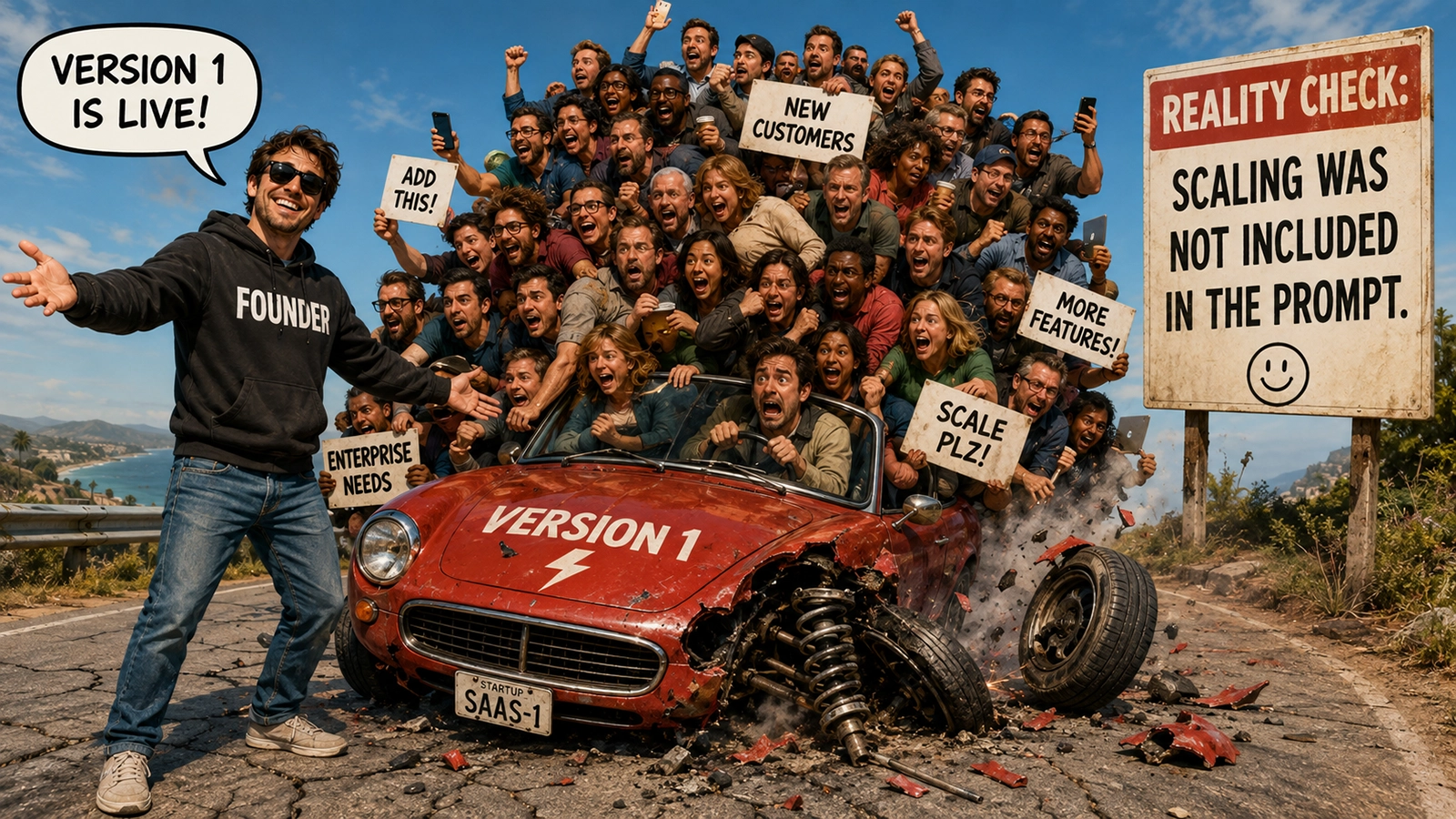
Version 1 is exciting.
You type:
“Build a CRM for roofing contractors.”
Boom.
Dashboard.
Contacts.
Deals.
Tasks.
Authentication.
Fancy charts.
Maybe even an AI assistant named something adorable.
Everyone celebrates.
Then Customer #37 says:
“We have three offices and each location needs separate permissions, but corporate needs visibility across all three.”
Customer #52 says:
“Can our accountant have access to invoices but not customer notes?”
Customer #81 says:
“Our webhook occasionally sends the same lead twice.”
Then Stripe changes something.
Google changes something.
Facebook changes something.
An API token expires.
A database table reaches four million rows.
One customer deletes something another customer somehow manages to see.
Congratulations.
You have now reached software development.
The demo was merely the appetizer.
Software Has a Second Half Nobody Posts About
People love posting screenshots of things they built with AI.
You rarely see this LinkedIn post:
“Day 472 of my AI SaaS journey. Today I fixed a corrupted queue worker, migrated 11 million records, rotated API credentials, repaired three failed webhooks and discovered why our billing reconciliation was off by $1,847.”
Not quite as sexy.
But that's software.
The first half is building features.
The second half is:
maintaining consequences.
And the second half lasts much longer.
The API Christmas Tree
Another temptation with AI development is how easy it becomes to connect everything.
Why stop with one AI provider?
Let's add five.
Then image generation.
Then video generation.
Then voice generation.
Then maps.
Then property data.
Then CRM integration.
Then social media publishing.
Then email.
Then SMS.
Then analytics.
Then payments.
Soon your architecture diagram looks like Clark Griswold's house at Christmas.
Every external service introduces:
- authentication,
- rate limits,
- billing,
- quotas,
- timeouts,
- retries,
- outages,
- version changes,
- permission changes,
- security concerns,
- logging requirements,
- error handling,
- and sometimes completely unexpected behavior.
Adding an API is easy.
Owning an API dependency is different.
That relationship may last longer than several marriages.

Claude Did Not Make You a Developer
This may hurt some feelings.
Signing up for Claude does not make you a software developer.
Just like buying Photoshop does not make you a graphic designer.
Buying a commercial smoker does not make you a pitmaster.
And owning a socket set definitely does not mean you should rebuild a transmission this weekend.
Tools expand capability.
They do not automatically create expertise.
A developer learns things the expensive way.
Through years of:
bad assumptions,
broken deployments,
database mistakes,
security issues,
terrible code they wrote fifteen years ago,
and bugs that only appear on Fridays at 4:57 PM.
Experience is basically a collection of scars with syntax highlighting.

But Here's the Other Side of This
Developers shouldn't become arrogant about AI either.
There are developers right now laughing at non-developers using AI to build applications.
Some of those non-developers are going to build successful businesses.
Why?
Because software development is not the only skill that matters.
A technically brilliant application solving a problem nobody cares about is still a failure.
Meanwhile, a founder who deeply understands an industry and uses AI to build a simple product solving a painful problem may create something very valuable.
That's why these tools are so disruptive.
They dramatically reduce the distance between:
idea
and
working prototype.
That is fantastic.
The mistake is assuming the distance between:
working prototype
and
sustainable software company
has disappeared.
It hasn't.
Where AI Works Best
The strongest model, in my opinion, isn't:
AI replaces developers.
And it isn't:
Developers ignore AI.
It's:
Experienced developers use AI to multiply their output.
That's how we're approaching FetchOne.
AI helps accelerate implementation.
But the important questions still require deliberate decisions.
Things like:
Who owns this data?
How are tenants isolated?
What happens when an agency manages multiple businesses?
What happens when someone changes organizations?
How do permissions cascade?
What happens when an API fails?
What does the audit trail show?
How do revisions work?
Can we safely undo this action?
What happens after 100 users?
What happens after 10,000?
What happens when the person who wrote this code isn't sitting in front of the computer anymore?
Those aren't glamorous questions.
They're also the reason software survives.
Architecture Is Boring Until You Need It
Nobody gets excited about architecture during the demo.
Customers don't say:
“WOW! Look at that normalized schema!”
Investors rarely leap out of their chairs yelling:
“THAT SERVICE CONTAINER IS BEAUTIFUL!”
But architecture becomes incredibly interesting when something goes wrong.
Good architecture lets you change things without destroying everything else.
Bad architecture turns every new feature into a hostage negotiation.
One developer changes the billing code and suddenly users can't upload profile pictures.
That's usually when somebody says:
“Claude seems confused.”
Claude isn't confused.
Claude is now trying to understand the archaeological site you created six months ago.
AI Doesn't Eliminate Technical Debt
Sometimes it manufactures it faster.
AI makes it incredibly easy to add things.
Feature?
Add it.
Integration?
Add it.
Dashboard?
Add it.
Automation?
Add it.
Another AI model?
Absolutely.
Eventually you can build a very impressive pile of capabilities.
The dangerous question is:
Do they belong together?
Software architecture isn't primarily about deciding what you can build.
It's deciding what you should build and where it belongs.
That discipline becomes even more important when the cost of writing code approaches zero.
The Shiny Object Problem
AI development also creates another business temptation.
Building is now incredibly fun.
New ideas become prototypes almost instantly.
This can be dangerous for entrepreneurs who already suffer from Shiny Object Syndrome.
You know the symptoms.
Monday:
“This is the company I'm building for the next ten years.”
Thursday:
“Hear me out... what if we built an AI-powered marketplace for alpaca insurance?”
emoji
When software took six months to build, ideas had friction.
Friction forced discipline.
Now you can prototype ten businesses before lunch.
That's wonderful for experimentation.
It's terrible if you mistake experimentation for commitment.
Great companies are usually built after the exciting part.
When the founder is still improving the same product after everyone else has become bored with hearing about it.

The Question Isn't “Can You Build It?”
That's becoming the wrong question.
AI is rapidly making the answer:
Probably.
The better questions are:
Can you maintain it?
Can you support customers?
Can you secure their data?
Can you monitor it?
Can you market it?
Can you measure whether it works?
Can you hire people?
Can you delegate?
Can you survive outages?
Can you make boring improvements for five years?
Can you resist rebuilding the entire application every time a new AI model releases?
Can you build a company instead of continually building another prototype?
Those are harder questions.
Claude cannot answer them for you.
The Great Opportunity
None of this means we should fear AI development.
Quite the opposite.
We're entering an extraordinary era.
Small development teams will build software that previously required entire departments.
One experienced developer may eventually produce what five or ten developers once produced.
Entrepreneurs who previously couldn't afford a prototype can now test ideas.
Businesses can automate workflows that previously couldn't justify custom software.
Specialists can create tools specifically for their industries.
That's incredible.
But we should understand what AI actually changed.
It dramatically reduced the cost of writing code.
It did not eliminate the need for:
judgment,
architecture,
experience,
discipline,
leadership,
operations,
marketing,
customer support,
or long-term commitment.
Those remain stubbornly human problems.
So Congratulations
You signed up for Claude.
You typed:
“Build me a SaaS.”
And twenty minutes later you had authentication, a dashboard and several gradients.
That's awesome.
Seriously.
Build something.
Experiment.
Learn.
Launch.
Create.
AI has opened doors that previously required enormous technical resources.
Just remember one thing.
When the first 200 customers arrive...
when the APIs start failing...
when the database grows...
when permissions get complicated...
when billing disagrees with accounting...
when one customer's data somehow appears where another customer's data should be...
and when the application you built eighteen months ago suddenly looks like it was written by an intoxicated raccoon...
that's when the developer part begins.
emoji
And Claude?
Claude will still be there.
Ready to help.
Probably saying:
“You're absolutely right. The current architecture could benefit from a small refactor.”
A small refactor involving 73 files.
Welcome to software development.
Bring coffee.